Sign inCreate account
← Lesson
Further theory lessons

Priority from the right or a manoeuvre?

Reason from the conditions, not from a memorised answer. Read the scene, choose, then open the explanation. The drawing is illustrative; the written conditions control the question.

1

Do not decide by position alone. First check for an officer, working lights and priority signs. Only then assess whether both vehicles are approaching an ordinary junction or one is performing a manoeuvre.

2

A driver leaving a parking place or private property must give way to other road users. Coming from your right and using an indicator do not cancel that obligation.

3

At an ordinary unsigned junction, a driver approaching lawfully from the right does not lose priority simply by stopping. Never interpret a pause or eye contact as a guaranteed invitation to cross.

Regulatory source ↗
Reviewed 2026-11-07

Apply the lesson · 3

Question 1 · Advanced scenarios

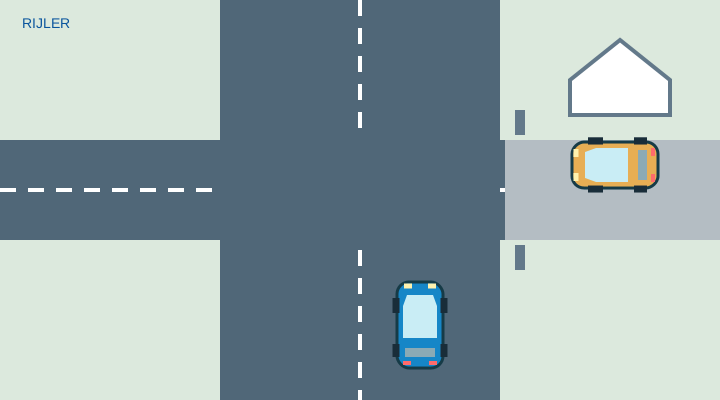
A car approaches from your right out of a clearly marked private driveway. You are driving along the public road. There are no lights, priority signs or officer. Who must give way?

Car leaving a private access on the right
Car leaving a private access on the rightBlue car: you. Gold car: other traffic. Diagram not to scale; use the written conditions.
  1. The car leaving the private driveway must give way to me.
  2. I must give way because the car is on my right.
  3. Whichever car reaches the edge first has priority.
Show the answer and explanation

Correct answer: A

The decisive detail is the private driveway, not the side. Leaving private property is a manoeuvre requiring giving way. Arrival order does not replace that rule; still watch for an unsafe pull-out.

Practice questions →

Question 2 · Advanced scenarios

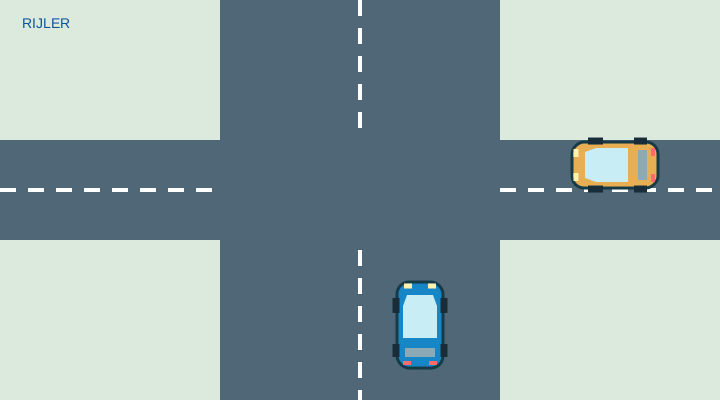
At an ordinary unsigned junction, a car lawfully approaches from your right. It pauses to check the junction; the driver gives no clear invitation. Has that pause transferred priority to you?

Two public roads meeting without priority signs
Two public roads meeting without priority signsBlue car: you. Gold car: other traffic. Diagram not to scale; use the written conditions.
  1. No. Merely stopping does not remove its priority from the right.
  2. Yes, provided I cross before it starts moving again.
  3. Yes, because stopping is equivalent to giving way to the left.
Show the answer and explanation

Correct answer: A

A short stop to observe is not a loss of priority. The question supplies no signs, officer or other exception. Do not turn the situation into a race to restart.

Practice questions →

Question 3 · Advanced scenarios

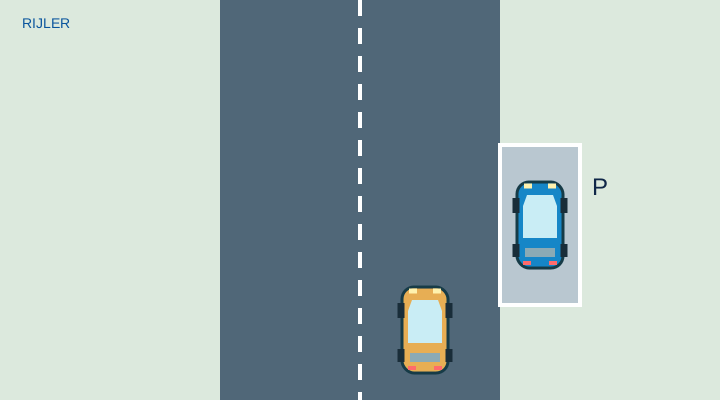
You leave a roadside parking bay and indicate left. A moving car approaches from behind in the lane you need. What does your indicator change?

Parked car beside an approaching vehicle
Parked car beside an approaching vehicleBlue car: you. Gold car: other traffic. Diagram not to scale; use the written conditions.
  1. It obliges the following car to slow down and let me out.
  2. It gives me priority once my front wheels cross the parking-bay line.
  3. It announces my intention; I still give way and wait for a safe gap.
Show the answer and explanation

Correct answer: C

Leaving a parking place remains a manoeuvre. Neither signalling nor moving the nose into the lane transfers priority. Look in mirrors and the blind spot before moving into a safe opening.

Practice questions →