Sign inCreate account
← Lesson
Further theory lessons

Cyclists: turning, overtaking and crossing

Reason from the conditions, not from a memorised answer. Read the scene, choose, then open the explanation. The drawing is illustrative; the written conditions control the question.

1

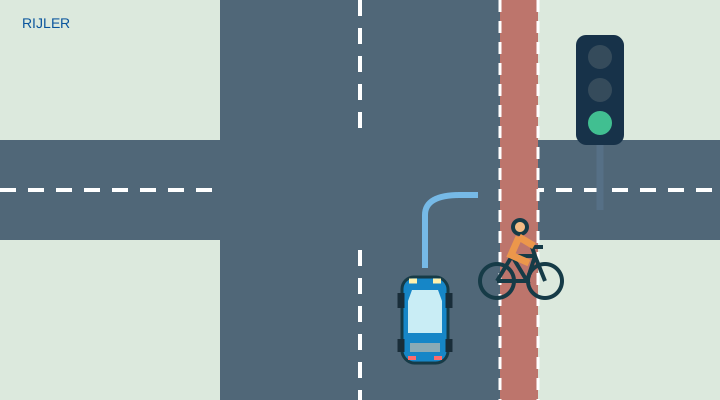
Before turning across a cycle path, check ahead, mirrors and the blind spot. A cyclist continuing along the same road can conflict with your turn even if your own traffic light is green.

2

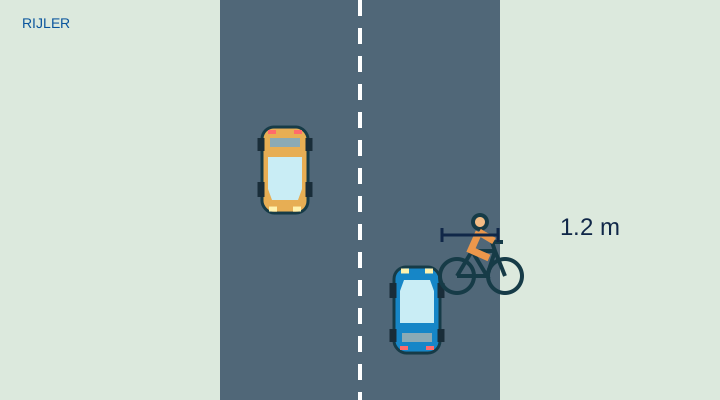
When overtaking a cyclist, leave at least 1 m inside a built-up area and 1.5 m outside it. These are minimum lateral distances, not a promise that every pass at that distance is safe.

3

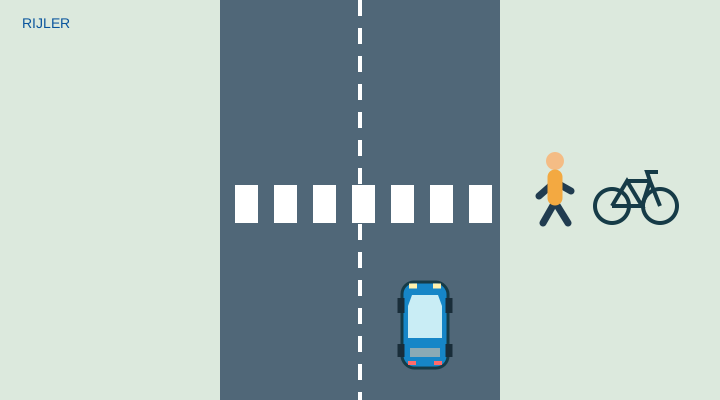
Distinguish a cyclist riding over a zebra crossing from a person walking beside a bicycle. The latter is a pedestrian. Whatever the priority, anticipate a possible crossing and avoid endangering the person.

Apply the lesson · 3

Question 1 · Advanced scenarios

You turn right across a marked cycle path. A cyclist on that path continues straight in the same direction. Both of you have green; no separate arrow gives you a protected turn. What do you do?

Right-turning car and cyclist on a continuing path
Right-turning car and cyclist on a continuing pathBlue car: you. Gold car: other traffic. Diagram not to scale; use the written conditions.
  1. Turn first because my green light permits the right turn.
  2. Turn first if I signalled before the cyclist reached my rear wheel.
  3. Give way to the cyclist before crossing the cycle path.
Show the answer and explanation

Correct answer: C

Green allows movement but does not remove your duty when crossing the cycle path. A timely indicator warns the cyclist; it does not take away their priority. Check the blind spot and wait outside the path.

Practice questions →

Question 2 · Advanced scenarios

Outside a built-up area, you can leave only 1.2 m beside a cyclist if you pass now. An oncoming car prevents a wider pass. What is the correct decision?

A 1.2 m passing gap and an oncoming car
A 1.2 m passing gap and an oncoming carBlue car: you. Gold car: other traffic. Diagram not to scale; use the written conditions.
  1. Pass slowly because 1.2 m is more than the 1 m minimum.
  2. Wait behind until I can pass safely with at least 1.5 m lateral clearance.
  3. Pass now if the cyclist stays on a straight line.
Show the answer and explanation

Correct answer: B

The location changes the minimum: outside a built-up area it is 1.5 m, so 1.2 m is insufficient. Reducing speed or assuming a steady cyclist does not replace that clearance. Wait without following too closely.

Practice questions →

Question 3 · Advanced scenarios

At an ordinary zebra crossing, a person gets off a bicycle and walks beside it, clearly intending to cross. There are no lights or tram tracks. How do you treat this person?

Person walking beside a bicycle at a zebra crossing
Person walking beside a bicycle at a zebra crossingBlue car: you. Gold car: other traffic. Diagram not to scale; use the written conditions.
  1. As a cyclist who must wait because a bicycle is present.
  2. As a pedestrian intending to use the crossing: give way.
  3. As a pedestrian only after the bicycle is fully on the crossing.
Show the answer and explanation

Correct answer: B

Walking beside a bicycle makes the person a pedestrian. At this ordinary crossing, a clearly intending pedestrian is given way; they need not first push the whole bicycle onto the road. A person riding across is a different case.

Practice questions →