Dashboard / BELGIAN CATEGORY B
Sign inCreate account
← Road position & overtaking
Apply the lesson · Standard

Road position & overtaking · Standard

Educational difficulty is separate from the legal penalty. These are original practice questions, not official examination items.

Lesson

Normally keep as far right as practicable on the carriageway.

Before overtaking, ensure you can see far enough and return safely.

A continuous white line must not be crossed to overtake.

A lane change is a manoeuvre: give way and signal your intention.

Do not accelerate while another driver is overtaking you.

Regulatory source ↗

Apply the lesson · 7

Question 1

On a normal two-way road with no obstacle or special lane rule, where should your car generally be positioned?
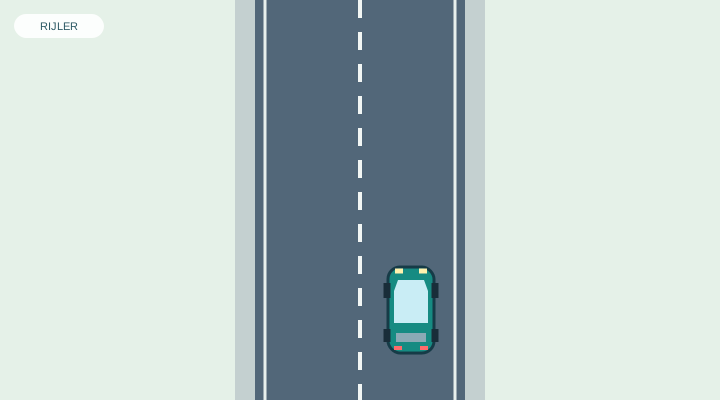
Road positioning
Road positioningOriginal educational diagram · not to scale. Read the question for all conditions.
  1. Close to the opposing lane for a better view.
  2. Across the centre line if traffic is light.
  3. Normally keep as far right as practicable on the carriageway.
Show the answer and explanation

Correct answer: C

Normally keep as far right as practicable on the carriageway.

Regulatory source ↗
Question 2

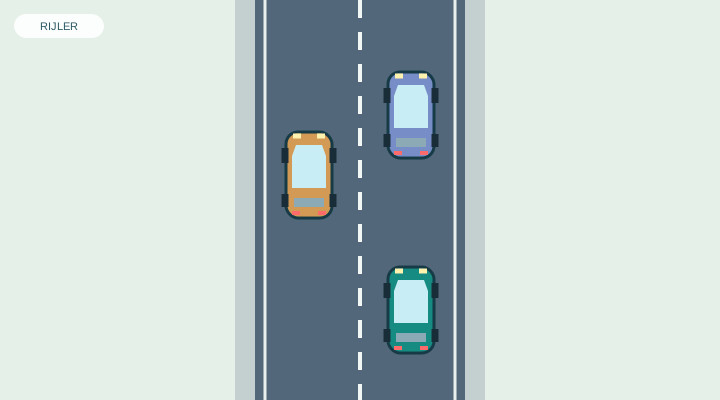
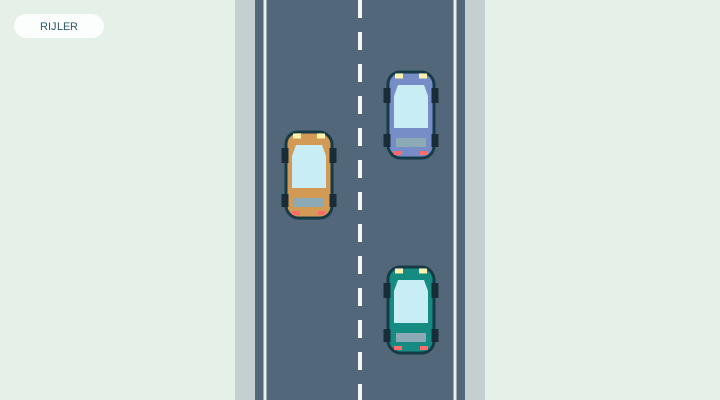
A slow vehicle is ahead but a bend hides oncoming traffic. Is this a safe moment to overtake?

Overtaking situation
Overtaking situationOriginal educational diagram · not to scale. Read the question for all conditions.
  1. Before overtaking, ensure you can see far enough and return safely.
  2. Yes, if your car accelerates strongly.
  3. Yes, because the other vehicle is slow.
Show the answer and explanation

Correct answer: A

Before overtaking, ensure you can see far enough and return safely.

Regulatory source ↗
Question 3

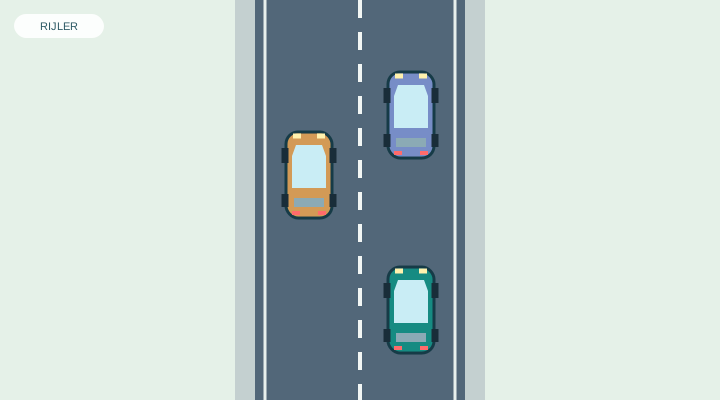
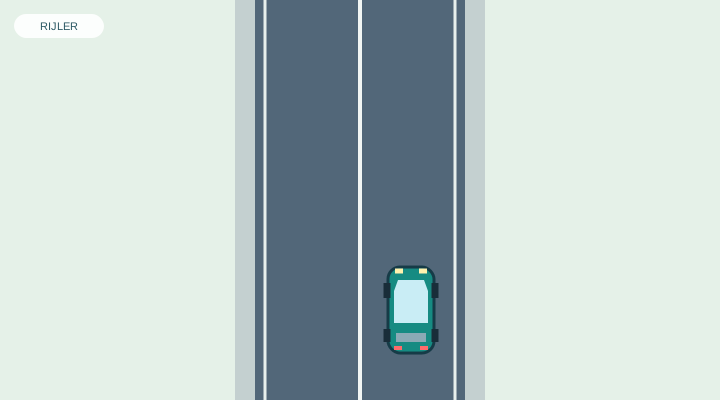
You want to pass a tractor, but the manoeuvre would cross a continuous white line. What applies?

Continuous centre line
Continuous centre lineOriginal educational diagram · not to scale. Read the question for all conditions.
  1. The tractor’s low speed cancels the marking.
  2. A continuous white line must not be crossed to overtake.
  3. Sounding the horn permits crossing the line.
Show the answer and explanation

Correct answer: B

A continuous white line must not be crossed to overtake.

Regulatory source ↗
Question 4

You signal to move into the adjacent lane, where another car is approaching. Does your indicator give you priority?

Adjacent lanes
Adjacent lanesOriginal educational diagram · not to scale. Read the question for all conditions.
  1. Yes, the approaching car must brake for you.
  2. Yes, after three indicator flashes.
  3. A lane change is a manoeuvre: give way and signal your intention.
Show the answer and explanation

Correct answer: C

A lane change is a manoeuvre: give way and signal your intention.

Regulatory source ↗
Question 5

Another car is overtaking you on an ordinary road. How should you treat your own acceleration?

Vehicle passing alongside
Vehicle passing alongsideOriginal educational diagram · not to scale. Read the question for all conditions.
  1. Do not accelerate while another driver is overtaking you.
  2. Accelerate to prevent it returning ahead of you.
  3. Race alongside until the manoeuvre ends.
Show the answer and explanation

Correct answer: A

Do not accelerate while another driver is overtaking you.

Regulatory source ↗
Question 6

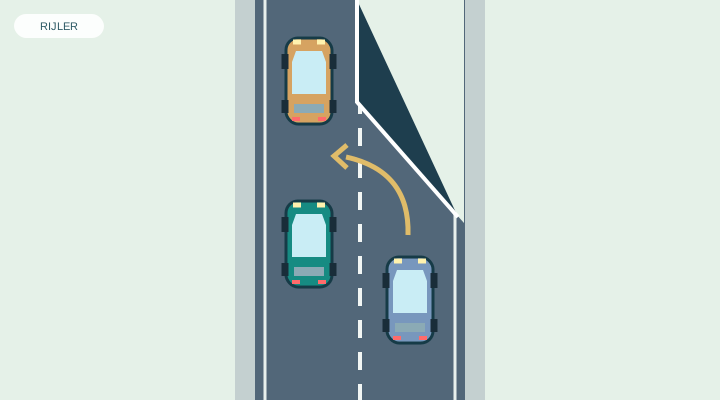
In heavily slowed traffic, your lane ends ahead. Where does the zipper rule place the merge?

Zipper merging
Zipper mergingOriginal educational diagram · not to scale. Read the question for all conditions.
  1. Anywhere, hundreds of metres earlier, with automatic priority.
  2. Only after driving through the blocked lane.
  3. Just before the narrowing.
Show the answer and explanation

Correct answer: C

When traffic is heavily slowed and a lane ends or is blocked, merge just before the narrowing. Drivers in the continuing lane let one merging vehicle in alternately. This special rule is not a general priority entitlement for every lane change.

Regulatory source ↗
Question 7

At a zipper merge in heavily slowed traffic, you are in the continuing lane. What should you allow?

Zipper merging
Zipper mergingOriginal educational diagram · not to scale. Read the question for all conditions.
  1. One merging vehicle alternately, just before the narrowing.
  2. Never leave a gap for a merging vehicle.
  3. Every vehicle in the ending lane goes before the continuing lane.
Show the answer and explanation

Correct answer: A

When traffic is heavily slowed and a lane ends or is blocked, merge just before the narrowing. Drivers in the continuing lane let one merging vehicle in alternately. This special rule is not a general priority entitlement for every lane change.

Regulatory source ↗