Dashboard / BELGIAN CATEGORY B
Sign inCreate account
← Vulnerable road users
Apply the lesson · Standard

Vulnerable road users · Standard

Educational difficulty is separate from the legal penalty. These are original practice questions, not official examination items.

Lesson

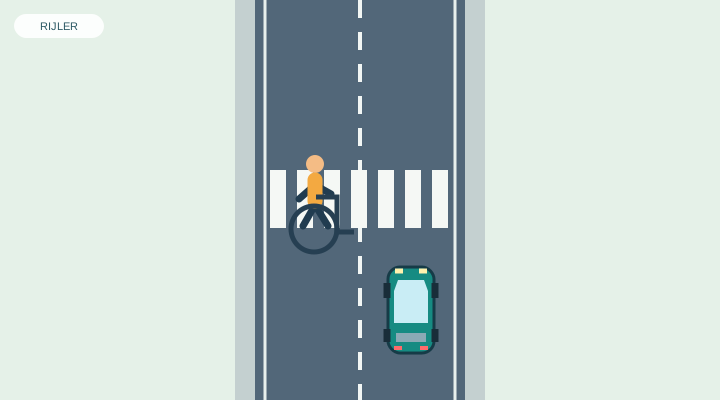
Give way to pedestrians who are crossing or about to cross at an unregulated pedestrian crossing.

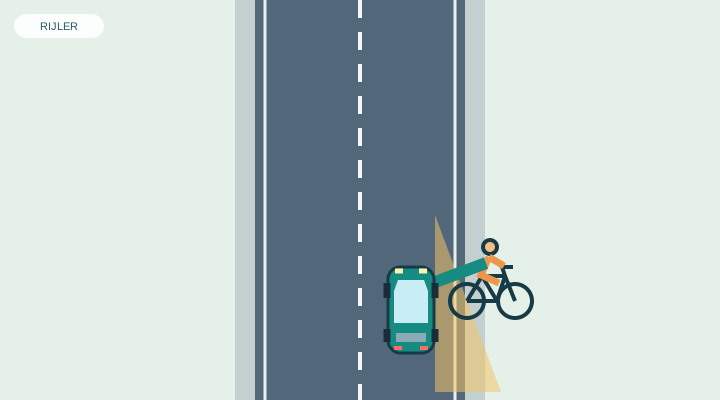
Check your blind spot for cyclists before turning right.

Children near the road may act unpredictably; slow down and be ready to stop.

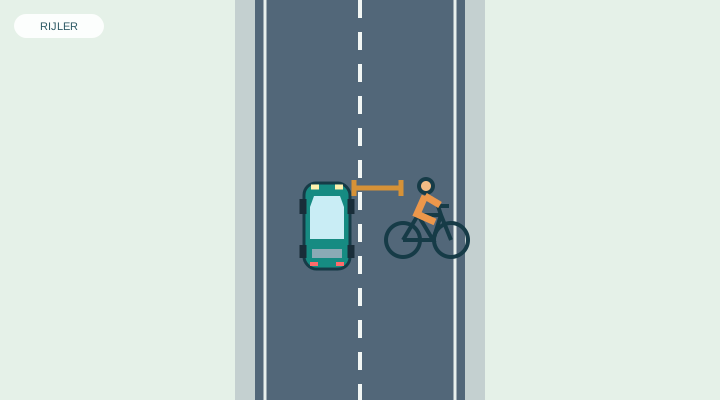
Before opening a car door, check for approaching cyclists and traffic.

Allow extra time and space for a pedestrian with reduced mobility.

Regulatory source ↗

Apply the lesson · 7

Question 1

A pedestrian is clearly about to enter an unregulated zebra crossing. What should you do?
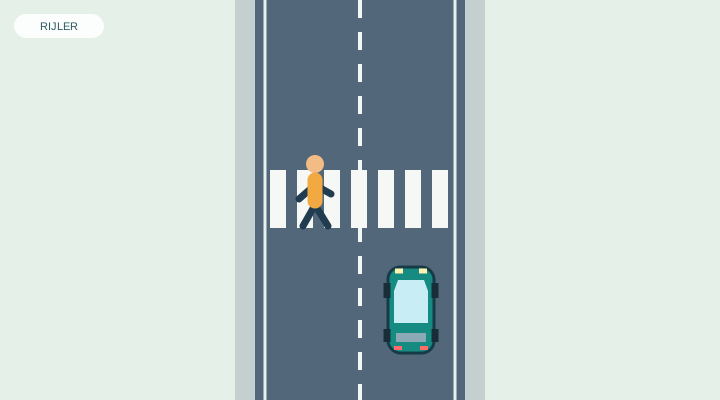
Pedestrian crossing
Pedestrian crossingOriginal educational diagram · not to scale. Read the question for all conditions.
  1. Give way to pedestrians who are crossing or about to cross at an unregulated pedestrian crossing.
  2. Keep speed until they reach the centre line.
  3. Signal with the horn and pass first.
Show the answer and explanation

Correct answer: A

Give way to pedestrians who are crossing or about to cross at an unregulated pedestrian crossing.

Regulatory source ↗
Question 2

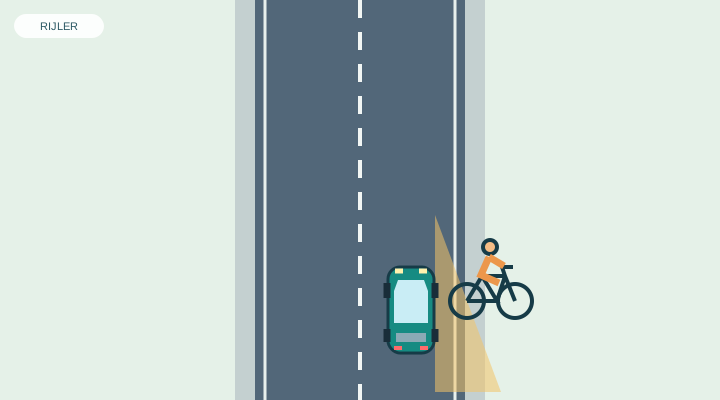
You checked your mirror before a right turn, but a cyclist may be alongside the passenger door. What check is still needed?

Cyclist in the blind spot
Cyclist in the blind spotOriginal educational diagram · not to scale. Read the question for all conditions.
  1. None: mirrors show every area around a car.
  2. Check your blind spot for cyclists before turning right.
  3. Only check the speedometer.
Show the answer and explanation

Correct answer: B

Check your blind spot for cyclists before turning right.

Regulatory source ↗
Question 3

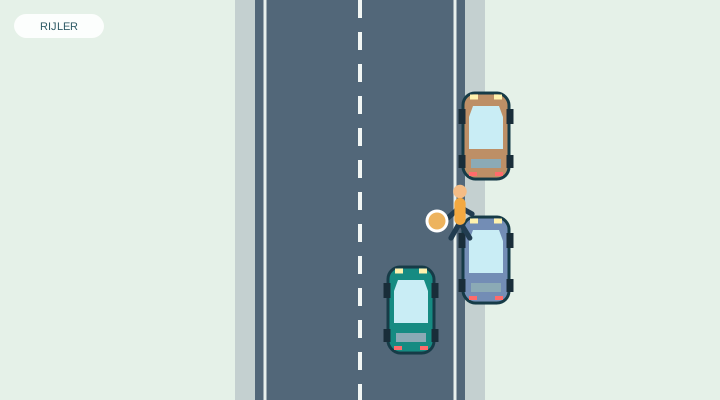
A ball rolls out between parked cars near a school. Which risk should influence your approach?

Child near parked cars
Child near parked carsOriginal educational diagram · not to scale. Read the question for all conditions.
  1. Children always wait safely until the road is empty.
  2. A horn makes slowing unnecessary.
  3. Children near the road may act unpredictably; slow down and be ready to stop.
Show the answer and explanation

Correct answer: C

Children near the road may act unpredictably; slow down and be ready to stop.

Regulatory source ↗
Question 4

You have parked beside a cycle route and are ready to open the door. What should happen first?

Opening a car door
Opening a car doorOriginal educational diagram · not to scale. Read the question for all conditions.
  1. Before opening a car door, check for approaching cyclists and traffic.
  2. Open quickly so cyclists can notice the door.
  3. Assume parked cars always have priority over cyclists.
Show the answer and explanation

Correct answer: A

Before opening a car door, check for approaching cyclists and traffic.

Regulatory source ↗
Question 5

An older pedestrian crosses slowly using a walking aid. What should shape your response?

Pedestrian with reduced mobility
Pedestrian with reduced mobilityOriginal educational diagram · not to scale. Read the question for all conditions.
  1. Move close to make them cross faster.
  2. Allow extra time and space for a pedestrian with reduced mobility.
  3. Assume everyone crosses at the same speed.
Show the answer and explanation

Correct answer: B

Allow extra time and space for a pedestrian with reduced mobility.

Regulatory source ↗
Question 6

Outside a built-up area, what minimum lateral distance must a car leave when passing a cyclist?

Passing cyclists
Passing cyclistsOriginal educational diagram · not to scale. Read the question for all conditions.
  1. 1.5 m
  2. 0.5 m
  3. 1 m
Show the answer and explanation

Correct answer: A

When passing a cyclist with a car, leave at least 1 metre laterally in a built-up area and at least 1.5 metres outside it. If you cannot leave adequate space safely, wait. A minimum gap is not permission to endanger a cyclist.

Regulatory source ↗
Question 7

In a built-up area, which is the minimum lateral gap for a car passing a cyclist, without endangering them?

Passing cyclists
Passing cyclistsOriginal educational diagram · not to scale. Read the question for all conditions.
  1. 0.5 m
  2. 1 m
  3. 0.25 m
Show the answer and explanation

Correct answer: B

When passing a cyclist with a car, leave at least 1 metre laterally in a built-up area and at least 1.5 metres outside it. If you cannot leave adequate space safely, wait. A minimum gap is not permission to endanger a cyclist.

Regulatory source ↗