A parked van can hide a cyclist or an approaching car. Identify the applicable priority rule before moving closer. Slow early and look along each approach; one glance from far away may leave an entire street unseen.
Lesson · Priority & junctions
An obscured junction: observe before committing
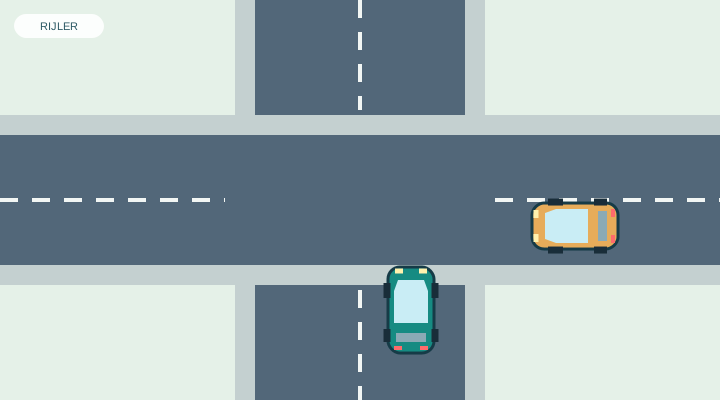
Advance only when you can observe and yield safely. Do not project the bonnet into a cycle crossing to obtain a view. Priority is a rule for resolving conflicts, not a reason to enter a collision you can avoid.
Regulatory source ↗ · Reviewed 2026-11-06
Apply the lesson
Educational difficulty is separate from the legal penalty. These are original practice questions, not official examination items.
Priority & junctions: which statement is correct? (1)
- Priority always belongs to the largest vehicle.
- At an unsigned junction, normally give priority to a driver approaching from your right.
- Using the horn gives you priority.
Show the answer and explanation
Correct answer: B
At an unsigned junction, normally give priority to a driver approaching from your right.
Regulatory source ↗Two cars reach an unsigned junction. The other car comes from your right. Neither is on rails or leaving a driveway. What applies?
- At an unsigned junction, normally give priority to a driver approaching from your right.
- Go first because you arrived a moment earlier.
- Only yield if the other car flashes its lights.
Show the answer and explanation
Correct answer: A
At an unsigned junction, normally give priority to a driver approaching from your right.
Regulatory source ↗Green light, no queue: an authorized officer facing you orders STOP. What applies first?
- Stop for the officer’s instruction.
- Proceed if the junction is clear, respecting other users.
- Stop completely, then give way.
Show the answer and explanation
Correct answer: A
Instructions from authorized officers take precedence. Working traffic lights regulate priority; with flashing amber, apply the signs. STOP requires a complete stop; B1 requires giving way.
Regulatory source ↗